The Boneyard Where Old Vegas Signs Go to Rest
8 min read
Picture a few acres of dirt behind a fence, and scattered across it like the bones of enormous animals, the signs. A genie lamp three stories tall. A skull that once grinned over a casino. The cracked letters of hotels that were dynamited decades ago. Everything is rusted, faded, dead.
This is the Neon Boneyard, and it is the closest thing Las Vegas has to a cemetery. Not for people. For the lights. Every sign here used to be somebody's dream, blazing over the Strip, promising the night of your life. Now they lie in the sun, waiting, and a handful of people are fighting to keep them from disappearing for good.
A town built out of light
To understand why the Boneyard matters, you have to understand what neon meant to Las Vegas. This was a city that learned early it could not compete on architecture or culture or weather. What it had was the night, and a willingness to light it up like nowhere else on earth. The sign was the building, in a sense. People did not remember the casino. They remembered the sign out front.
From the 1930s onward, a small army of sign makers turned the desert into the brightest place in America. Companies like the Young Electric Sign Company, known to everyone as YESCO, employed designers and glass benders and electricians who pushed neon and incandescent bulbs to do things nobody had tried before. A sign was not a label. It was a performance, animated, towering, impossible to ignore.
These were genuine works of art, even if nobody called them that at the time. A great Las Vegas sign had movement, color, personality, and scale. It had to stop a tired driver from a thousand feet away and convince him to pull in. The best sign designers in the country worked here because here was the only place that would let them go this big and this bold.
But signs live hard lives. They run all night, every night, baking in the desert heat and freezing on winter mornings. And when a casino closes, gets sold, or gets imploded to make room for the next big thing, the sign comes down. For most of the city's history, down meant gone. Scrapped. Melted. Thrown away like trash.
The graveyard nobody planned
YESCO, the company that built so many of these signs, kept some of them. When a sign came down and the casino did not want it, the company would sometimes haul it to a back lot and just leave it. Over the years that lot filled up with giants. It was not a museum. It was storage, a junkyard, a place where dead signs piled up because nobody had a better idea.
And yet people started to notice it. There was something haunting about a field full of these things. A skull from the Treasure Island days. The lamp from the Aladdin. The horseshoe from a downtown casino. Letters and stars and arrows from places that had been famous and were now forgotten. Walking through it felt like walking through the ruins of a lost civilization, except the civilization was barely a generation old.
The problem with a junkyard is that junk gets thrown out. These signs were rusting away, and there was no one whose actual job it was to save them. A few people who cared about the city's history looked at that field of dying giants and realized that if somebody did not act, the visual memory of old Las Vegas was going to vanish completely, melted down for scrap metal.
So a nonprofit formed with a simple, stubborn mission. Save the signs. Collect them, protect them, and someday show them to the public so people could understand where the Las Vegas of glass and steel had actually come from. That effort became the Neon Museum.
Saving the dead
Rescuing a neon sign is harder than it sounds. These things are enormous, fragile, and full of hazards. The glass tubing shatters. The metal is heavy and sharp. The old transformers and wiring can be dangerous. Moving a sign the size of a building, one that has been sitting outside for decades, is a delicate and expensive operation.
And then there is the question of what saving even means. Restoring a sign to full working glory, with the neon glowing and the bulbs chasing, costs a fortune. You cannot do that for hundreds of signs. So the museum made a choice that turned out to be the right one. Most of the signs would be preserved as they were, rusted, weathered, beautifully ruined, displayed exactly in the state that time had left them.
That choice is what makes the Boneyard so powerful. You are not looking at a shiny recreation. You are looking at the real thing, scarred and faded, with the desert sun pouring over peeling paint and broken glass. It feels honest in a way a restored sign never could. These are the actual objects that hung over the actual Las Vegas, and they wear every year of it.
To anchor the whole place, the museum brought in the old lobby of the La Concha Motel, a swooping, shell-shaped mid-century building that was itself a piece of endangered Las Vegas design. They moved it, restored it, and made it the visitor center. The gateway to the graveyard of signs was, fittingly, a rescued building that had nearly been lost too.
Ghosts in the dark
The Boneyard is best after sunset. During the day you see the rust and the ruin. At night, with careful lighting and a handful of restored signs glowing, the place transforms into something else entirely. Tours wind through the lot in the dark, and the guides tell the stories. This sign hung over a casino run by men you would not want to owe money. That one welcomed the Rat Pack. This lamp shone over a hotel that no longer exists in any form.
Every sign is a portal to a vanished Las Vegas. The Stardust, the Sahara, the original Aladdin, the downtown joints that have been remodeled past all recognition. The buildings are gone, imploded in clouds of dust to make way for the next era. But the signs survived, and standing among them you can almost reassemble the city that used to be.
That is the strange gift of the Boneyard. Las Vegas is famous for erasing itself. It tears down its own history with a kind of cheerful ruthlessness, always chasing the newer, bigger, shinier thing. A town like that does not usually keep souvenirs. The Neon Museum is the rare place where the old Las Vegas was allowed to stick around, even if only as a beautiful corpse.
Walk through it and you understand the city better than any guidebook will teach you. You see how much was built, how fast it rose, and how quickly it fell. You see the dreams that worked and the dreams that died. And you see them in their own light, literally, glowing again in the desert dark.
Why we keep the bones
There is a reason cultures bury their dead instead of forgetting them. Memory is how a place knows itself. A city that throws away every trace of its past is a city that does not really know who it is. Las Vegas came close to being exactly that kind of place, a town with no yesterday, endlessly rebuilding itself into a stranger.
The Boneyard is the argument against that. It says these signs mattered. The people who designed them were artists. The places they advertised were real, full of real history, real characters, real lives. Keeping the signs is a way of refusing to let all of that simply evaporate the way buildings do when the dynamite goes off.
The collection keeps growing, because Las Vegas keeps tearing things down. Every time a casino closes or gets a new name and a new face, there is a chance another sign ends up behind that fence in the desert, joining the others. The graveyard fills slowly, one giant at a time.
So the lights that once sold the city its fantasies now do quieter work. They remind us. They are the bones of every Las Vegas that came before this one, laid out in the sun and lit up at night, kept safe by people who decided that even a town built on the future deserves to remember its past.
Frequently asked
What is the Neon Boneyard?
It is the outdoor collection of the Neon Museum, an open lot in Las Vegas filled with old neon and electric signs rescued from casinos and businesses that have closed or been demolished. Many are displayed in their original weathered condition rather than fully restored.
Why aren't all the signs lit up and restored?
Full restoration of a neon sign is extremely expensive, and the museum holds far too many signs to restore them all. The museum chose to preserve most signs in their aged state, which keeps them authentic and lets visitors see the real objects exactly as time left them. A selection is illuminated for night tours.
What is the shell-shaped building at the entrance?
It is the former lobby of the La Concha Motel, a mid-century building that was itself saved from demolition, relocated, and restored to serve as the Neon Museum's visitor center.
More Vegas history
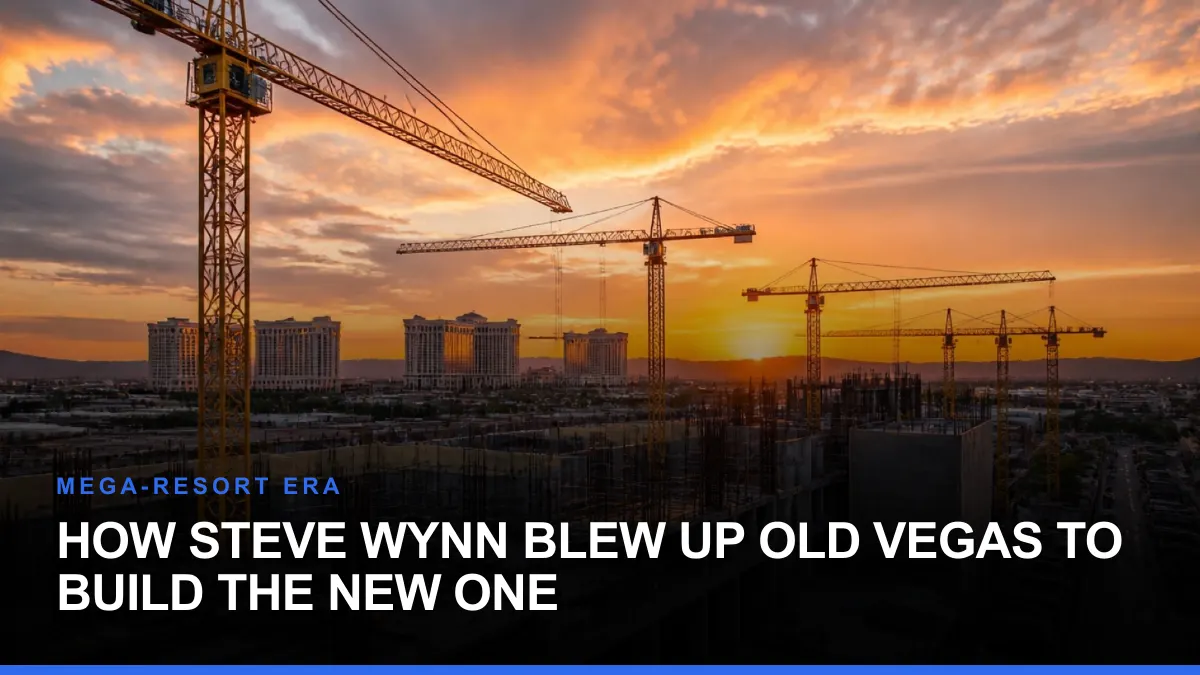
How Steve Wynn Blew Up Old Vegas to Build the New One
A volcano, a pile of junk bonds, and a string of implosions. The story of how the modern Strip replaced the mob's Vegas.
When Vegas Sold Tickets to the Atomic Bomb
For about a decade, the hottest show in town was a mushroom cloud on the horizon. Vegas turned nuclear tests into a tourist attraction.
The Summit at the Sands: When the Rat Pack Ran Vegas
For a few weeks in 1960, Sinatra and his friends filmed a movie by day and owned the Copa Room by night. It was the coolest Vegas ever got.